
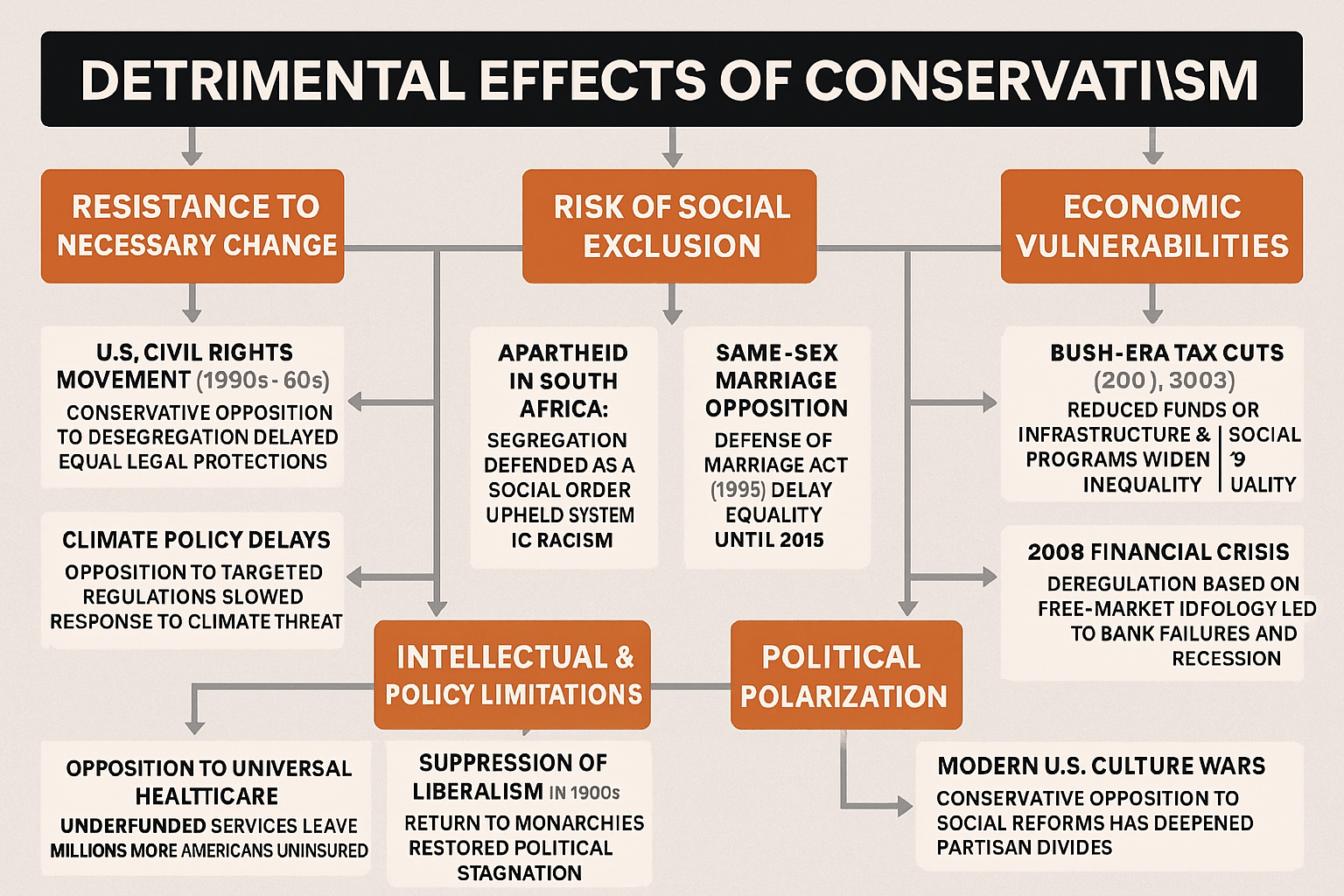
Conservatism, like any political ideology, has both advocates and critics. When critics talk about its detrimental effects, they often point to patterns that can emerge when its principles are applied rigidly or without adaptation to changing circumstances. Here are some of the most commonly cited drawbacks:
Let’s ground those potential downsides of conservatism in concrete historical and contemporary examples. These illustrate how the principles, when applied rigidly, have sometimes produced the kinds of effects we discussed earlier.
Sources
Three Problems with Conservatism | Libertarianism.org
Pros and Cons of Conservatism – Pros an Cons
The Impact of Conservatism

If you vote for Trump and his MAGA GOP members you may indirectly start World War III.
If Trump and his MAGA GOP take control of our Congress, they will cut off support for Ukraine. They already cut support on the advice of Trump when the Congress was ready to approve the spending bill with support for Ukraine.
What will happen next?
said Larry Jacobs, director of the Center for the Study of Politics and Governance at the University of Minnesota. “This is supposed to be the party of conservative principles, of tradition, of respect for customs and rules that make society governable.
“The idea that the law does not apply to Republicans is something that has now become part of the mainstream of the Republican party. We see it in terms of the approach to elections. We see it in terms of the treatment of immigrants. Some of the actions with regard to abortion may approach that level. The Republican party appears to consider the law and the constitution to be optional and to have lost legitimacy.”
From The Guardian
Republicans’ lawless leaders at odds with midterm law and order message | Republicans | The Guardian
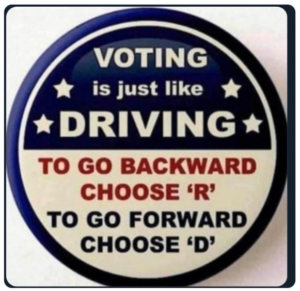
If you vote Republican you are supporting:
– 19 GOP red states have pending laws suppressing voter’s ability to vote. Historically, dictators and Fascists have suppressed votes to stay in power.
– The GOP has come out in support of QAnon, The Oath Keepers and the Proud Boys
– You may lose a loved one, a relative or a friend in a train crash, a bridge collapse or a plane crash as Republicans strip funds from President Biden’s infrastructure bill.
– The Texas abortion ban if left to stand will be passed in several other GOP states. Idaho will pass an anti-abortion law based on the Texas law. 16 states have “trigger” abortion ban laws.
by the US Supreme Court.
https://cnn.it/3RaW1zm
https://nyti.ms/3IcANNo
With the recent Supreme Court banning EPA authority from polluters
https://bit.ly/3IfQ1Bf
on Gun Purchases – will never get passed.
Watch Jimmy Kimmel’s emotional plea to improve gun purchase background checks
https://cnn.it/3AnRweO
– will never go up leaving 18 states still paying $7.25 an hour.
– the last thing America needs are conservative leaders, especially some Republicans who want to keep America from progressing. The last thing America needs is backward-thinking leaders in the 21st Century.
– Republicans have turned to cheating to stay in power or to get back into power…and nothing is getting done by them for the American people.
The enforcement or advocacy of strict obedience to authority at the expense of personal freedom.
and everything America stands for: Truth, Justice and Liberty for all? Look what is happening in Ukraine.
*Of course, not all Republicans are like those described above. Here is a list of those who should stay in office.
House of Representatives – those who voted to impeach the former president
Senate – The Republicans who voted to convict the former president after impeachment:
YOUR VOTE COUNTS. It’s a lie to think otherwise.
Paid for by Jake Stone for American Democracy
VOTE like your freedom depended on it…because it does.


 Books of the NY Times