• +1 919.961.0198
  • info@outerbankspublishing.com

Category ArchiveMiscellaneous

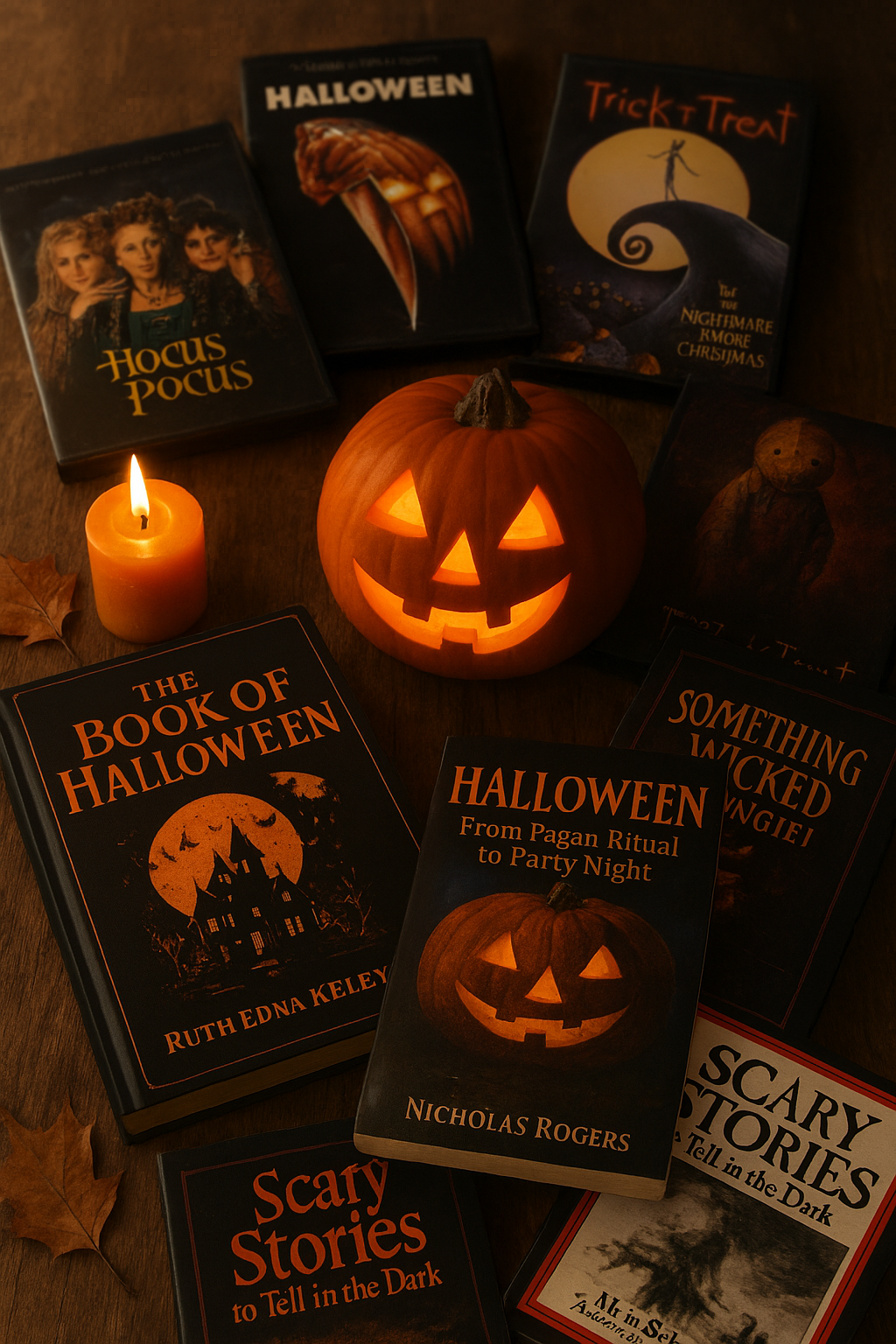
Halloween-inspired image captures the eerie charm of jack-o'-lanterns, misty moonlight, trick-or-treaters, and a cozy stack of spooky books and movies.

Do you know what Halloween is really about?

Halloween is more than costumes and candy—it’s a centuries-old celebration rooted in ancient rituals, spiritual beliefs, and cultural evolution. This blog post explores its origins and highlights books and movies that capture its eerie magic.


🎃 What Is Halloween Really About?

Halloween, celebrated every October 31st, traces its roots to the ancient Celtic festival of Samhain. Over 2,000 years ago, the Celts marked the end of summer and the beginning of the dark winter with Samhain, believing that on this night, the boundary between the living and the dead blurred. Spirits were thought to roam the earth, and people lit bonfires and wore costumes to ward them off Rosetta Stone History.

In the 8th century, Pope Gregory III designated November 1st as All Saints’ Day, incorporating some Samhain traditions. The night before became All Hallows’ Eve, eventually shortened to Halloween. Over time, the holiday evolved into a community-centered celebration with trick-or-treating, jack-o’-lanterns, and spooky storytelling History.


📚 Books That Explore Halloween and Its Haunting Themes

Whether you’re curious about Halloween’s history or craving a chilling read, these books offer both insight and spine-tingling entertainment:

  • “The Book of Hallowe’en” by Ruth Edna Kelley – Written in 1919, this classic explores the origins and customs of Halloween, from ancient rituals to modern traditions Rosetta Stone.
  • “Halloween: From Pagan Ritual to Party Night” by Nicholas Rogers – A scholarly yet accessible dive into how Halloween transformed from a spiritual observance to a pop culture phenomenon.
  • “Something Wicked This Way Comes” by Ray Bradbury – A haunting tale of two boys who confront evil in a traveling carnival. Bradbury’s poetic prose captures the essence of Halloween’s eerie allure.
  • “Scary Stories to Tell in the Dark” by Alvin Schwartz – A collection of terrifying tales and folklore, perfect for reading aloud on Halloween night.

🎬 Iconic Halloween Movies to Set the Mood

Halloween wouldn’t be complete without a few cinematic scares. These films have become staples of the season:

  • “Halloween” (1978) – John Carpenter’s slasher classic introduced the world to Michael Myers and redefined horror cinema.
  • “Hocus Pocus” (1993) – A cult favorite that blends comedy and witchcraft, perfect for family-friendly frights.
  • “The Nightmare Before Christmas” (1993) – Tim Burton’s stop-motion masterpiece blurs the line between Halloween and Christmas with gothic charm.
  • “Trick ‘r Treat” (2007) – An anthology of interconnected stories that explore Halloween traditions with a dark twist.

🕯️ Why Halloween Still Matters

Halloween is more than just a night of costumes and candy—it’s a celebration of mystery, imagination, and the thin veil between worlds. It invites us to confront our fears, honor the past, and revel in the macabre. Whether you’re reading about its origins, watching a horror flick, or diving into a spooky novel, Halloween offers a unique lens into our cultural fascination with the unknown.

So light a candle, carve a pumpkin, and let the spirits of Halloween guide your night.


Sources: Rosetta Stone History istruestory.com

Photo and story created by Copilot
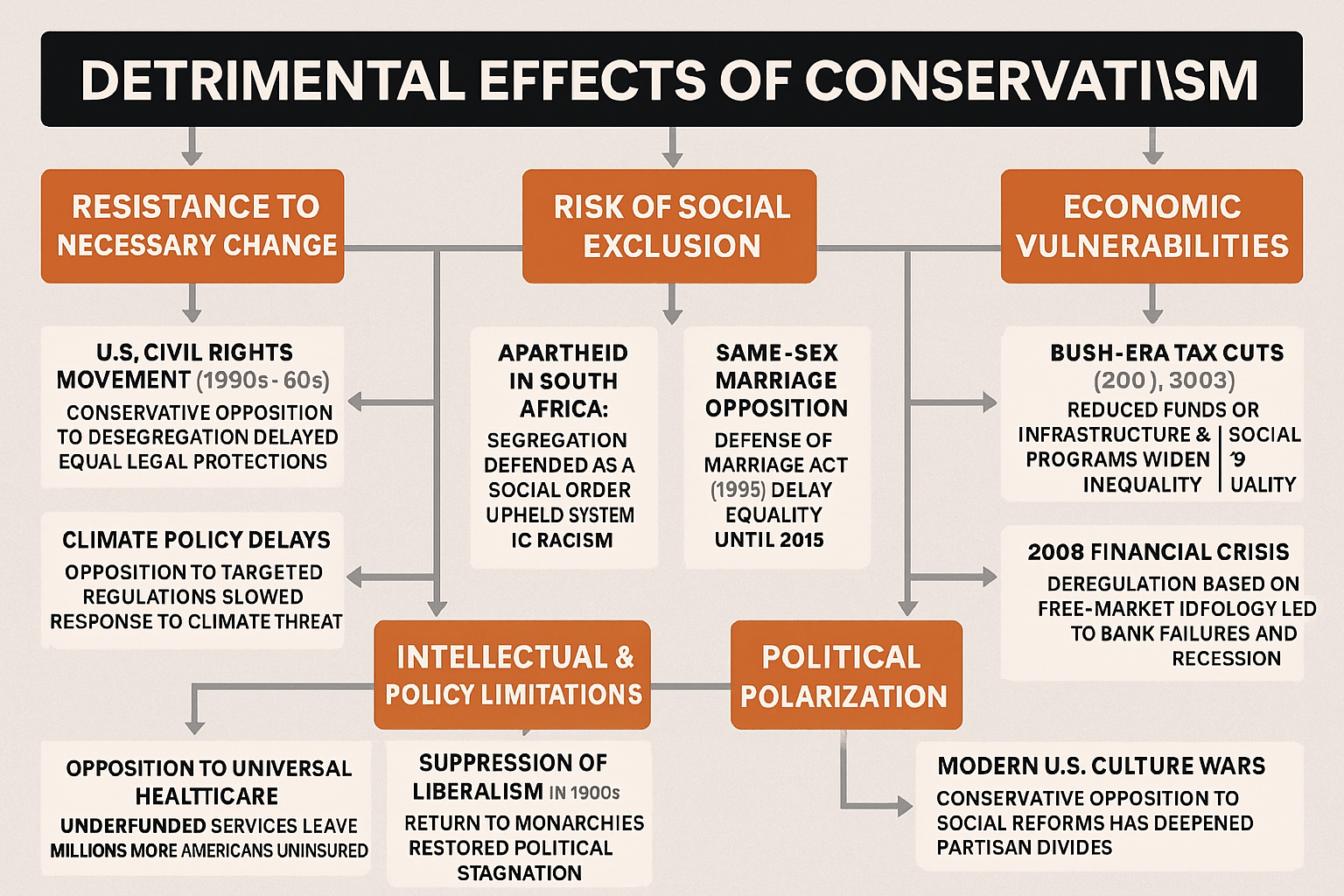
Infographic on effects of conservatism

So you want to be a conservative?

Conservatism, like any political ideology, has both advocates and critics. When critics talk about its detrimental effects, they often point to patterns that can emerge when its principles are applied rigidly or without adaptation to changing circumstances. Here are some of the most commonly cited drawbacks:


⚖️ Resistance to Necessary Change

  • Inertia in the face of urgent problems – By prioritizing tradition and gradual change, conservatism can delay reforms needed to address pressing issues like climate change, systemic inequality, or technological disruption.
  • Arbitrary “freeze points” in history – Critics argue that choosing a past era as the ideal can be subjective and ignore the fact that those traditions were themselves products of change.

🛑 Risk of Social Exclusion

  • Marginalization of minority groups – A strong emphasis on preserving traditional social norms can unintentionally (or intentionally) uphold systems that disadvantage women, racial minorities, or LGBTQ+ communities.
  • Cultural stagnation – Overprotecting established norms may limit cultural innovation and diversity.

💰 Economic Vulnerabilities

  • Underfunded public services – Policies favoring low taxation and minimal government intervention can reduce resources for education, healthcare, and infrastructure, potentially widening inequality.
  • Economic fragility – If tax cuts aren’t offset by other revenue, governments may face budget shortfalls, increasing vulnerability to economic shocks.

🧠 Intellectual and Policy Limitations

  • Inoperative for future planning – Some political theorists argue conservatism struggles to offer proactive solutions for emerging challenges, since it often looks backward for guidance.
  • Overreliance on precedent – This can lead to missed opportunities for innovation in governance, technology, and social policy.

⚔️ Political Polarization

  • Entrenchment of divisions – By framing politics as a defense of tradition against progressive change, conservatism can deepen ideological divides and make compromise harder.

Real World Examples of Conservatism

Let’s ground those potential downsides of conservatism in concrete historical and contemporary examples. These illustrate how the principles, when applied rigidly, have sometimes produced the kinds of effects we discussed earlier.


⚖️ Resistance to Necessary Change

  • U.S. Civil Rights Movement (1950s–60s) – Many conservative politicians and voters opposed desegregation and civil rights legislation, arguing for the preservation of “traditional” social structures. This resistance delayed equal legal protections for African Americans by years, sometimes decades, in certain states.
  • Climate Policy Delays – In multiple countries, conservative parties have resisted aggressive climate action, prioritizing economic growth and existing industries (like coal and oil) over rapid environmental regulation. Critics argue this has slowed the global response to climate change, increasing long-term costs.

🛑 Risk of Social Exclusion

  • Same-Sex Marriage Opposition – In the U.S., the Defense of Marriage Act (1996) reflected a conservative push to define marriage as between a man and a woman. This delayed marriage equality until the Supreme Court’s Obergefell v. Hodges decision in 2015.
  • Apartheid in South Africa – Conservative political forces defended racial segregation policies for decades, citing the preservation of “traditional” societal order, which entrenched systemic inequality until the early 1990s.

💰 Economic Vulnerabilities

  • 2008 Financial Crisis – Deregulation of the U.S. financial sector, supported by free-market conservative ideology, contributed to risky lending practices and the housing bubble. The collapse triggered a global recession, showing the dangers of underregulated markets.
  • Bush-Era Tax Cuts (2001, 2003) – These cuts disproportionately benefited the wealthiest Americans, widening income inequality while reducing federal revenue, which critics say constrained public investment in infrastructure and social programs.

🧠 Intellectual and Policy Limitations

  • Opposition to Universal Healthcare in the U.S. – Conservative resistance to expanding public healthcare programs has left the U.S. with higher uninsured rates compared to other developed nations, impacting public health outcomes.
  • Suppression of Liberal Movements in 19th-Century Europe – Austrian statesman Klemens von Metternich’s conservative policies after the Napoleonic Wars restored monarchies and suppressed democratic movements, creating political stagnation and unrest that later erupted in the Revolutions of 1848.

⚔️ Political Polarization

  • Modern U.S. Culture Wars – Conservative-led opposition to progressive social reforms (on issues like gender identity, immigration, and education curricula) has deepened partisan divides, making bipartisan governance increasingly rare.

This article was generated by artificial intelligence.

Sources

Three Problems with Conservatism | Libertarianism.org
Pros and Cons of Conservatism – Pros an Cons
The Impact of Conservatism

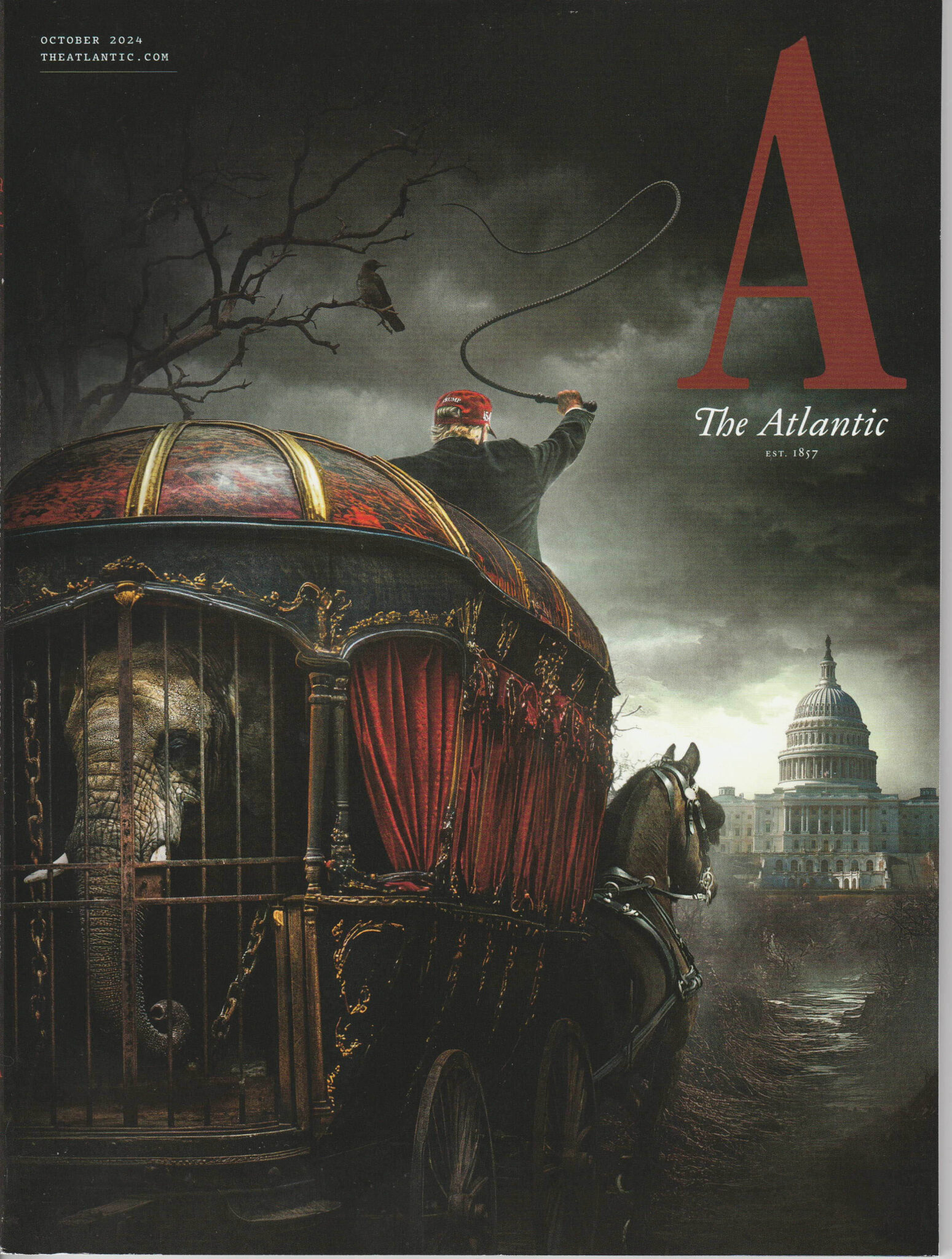
This is the cover of October 2024 edition of The Atlantic magazine created by Justin Merz based on the visual language of old Ray Bradbury and Stephen King paperbacks to portray a circus wagon on its nefarious approach to the Capital. Something Wicked This Way Comes, Bradbury's 1962 masterpiece was a strong influence about Mr. Dark, who grifts strangers into joining his malevolent carnival.

Today is a sad day for America

A convicted felon enters the White House for the first time in the history of our country.

Our forefathers of the Constitution never thought the American people would vote for a criminal with such nefarious qualities and no soul.  They never imagined that American voters could be so morally and ethically bankrupt and didn’t adopt any provisions in our Constitution to address such an unthinkable scenario. But here we are in 2025 almost 250 years later.

Maybe, the voters who put him there deserve what will happen to them in the next four years or what will not happen. They believed the con he was putting forth even though he proved beyond a doubt in the last eight years that he is a pathological  liar, sexual predator, and a racist. And as philosopher George Santayana, who is credited with saying “Those who cannot remember the past are condemned to repeat it” is now true and happening today.

The featured photo above with elephant in the cage is from the October 2024 cover of The Atlantic magazine and depicts the current Republican party – soul-less, cowardly, and all fearing of the person driving the circus wagon soon to reach the White House. If one opened the cage and forced the elephant out, gave him a conscience and freedom to act on his own, he would turn and stomp, and struggle desperately to get back into the cage. They are truly Trump’s slaves programmed to obey his every whim.

The Trump cancer appeals to the MAGA Republicans and his allies because it addresses a basic, depraved instinct – selfishness. The Republican party is the party of selfishness because they believe they will get what they want supporting Trump – to stay in power, obtain more power, get richer, and do what they want with no accountability. To hell with the voters who put them in office or how much suffering it will instill on the American people and the damage it will do to America and the world.

It’s ironic that Monday is also Martin Luther King, Jr. Day, a federal holiday. Dr. King unselfishly lived and died for Civil rights in this country for all Americans. His dream may be shattered in the next four years.

It is a sad day for America.

___________________________

This is the cover of October 2024 edition of The Atlantic magazine created by Justin Merz based on the visual language of old Ray Bradbury and Stephen King paperbacks to portray a circus wagon on its nefarious approach to the Capital. Something Wicked This Way Comes, Bradbury's 1962 masterpiece was a strong influence about Mr. Dark, who grifts strangers into joining his malevolent carnival.The October 2024 cover of The Atlantic magazine was created by Justin Merz based on the visual language of old Ray Bradbury and Stephen King paperbacks to portray a circus wagon on its nefarious approach to the Capital.

Something Wicked This Way Comes, Bradbury’s 1962 masterpiece was a strong influence about Mr. Dark, who grifts strangers into joining his malevolent carnival.
It’s fitting that the cover was created by The Atlantic magazine which was started in Boston the spring of 1857 by thinkers, authors, and writers of American letters who fiercely opposed slavery and who believed the free exchange of ideas across ideological lines was crucial to the great American experiment.
The editors believe this is the first cover in its 168-year history that bears no headline or typography because the image speaks for itself.
We are with Ukraine

We Stand with Ukraine

We Stand with Ukraine

Click here to download a “We Are With Ukraine” image to put in your window or post online.
And then dig deep to donate whatever you can directly to World Central Kitchen, which is serving fresh meals to people forced to flee the invasion, inside Ukraine and in neighboring countries.

Want to help?

Read the story about people booking Airbnb homes and rooms in Kiev, but don’t plan to go there. The funds go to Ukrainian Airbnb hosts and are used for the bombed-out residents for food, medicine and other essentials.

Stories about the Ukraine

See the video on bombed residential areas in Ukraine that have no military significance.
CNN, March 6, 2022

1. “Attack on Ukraine brings rare sight in Russia: Protests in cities against Putin and invasion,” The Washington Post, February 24, 2022
2. “European Parliament Backs Ukraine’s EU Application, But Long Road Ahead,” Newsweek, March 1, 2022
3. “As over 100,000 rally for Ukraine, Germany announces vast defense spending increase that may upend European security policy,” The Washington Post, February 27, 2022
4. “Munich Philharmonic drops star conductor Valery Gergiev over Putin ties,” DW Akademie, March 1, 2022
5. “EU says expects millions of displaced Ukrainians,” Reuters, February 27, 2022
6. “Ukraine’s Kharkiv struck by cluster bombs, experts say,” Reuters, March 1, 2022
7. “What are cluster and vacuum weapons, and how has Russia used them in the past?,” The Washington Post, March 2, 2022
8. “Russian Troop Deaths Expose a Potential Weakness of Putin’s Strategy,” The New York Times, March 2, 2022

Happy New Year 2019!


WHEREVER THE TIDE OF LIFE TAKES YOU AND YOUR LOVED ONES

The Origin of New Year’s Day

From the History Channel

The first New Year’s Day was celebrated on January 1 in the year 45 B.C. for the first time in history as the Julian calendar took effect.

Soon after becoming Roman dictator, Julius Caesar decided that the traditional Roman calendar was in dire need of reform.

Introduced around the seventh century B.C., the Roman calendar attempted to follow the lunar cycle but frequently fell out of phase with the seasons and had to be corrected. In addition, the pontifices, the Roman body charged with overseeing the calendar, often abused its authority by adding days to extend political terms or interfere with elections.

In designing his new calendar, Caesar enlisted the aid of Sosigenes, an Alexandrian astronomer, who advised him to do away with the lunar cycle entirely and follow the solar year, as did the Egyptians.

The year was calculated to be 365 and 1/4 days, and Caesar added 67 days to 45 B.C., making 46 B.C. begin on January 1, rather than in March. He also decreed that every four years a day be added to February, thus theoretically keeping his calendar from falling out of step.

Shortly before his assassination in 44 B.C., he changed the name of the month Quintilis to Julius (July) after himself. Later, the month of Sextilis was renamed Augustus (August) after his successor.

Celebration of New Year’s Day in January fell out of practice during the Middle Ages, and even those who strictly adhered to the Julian calendar did not observe the New Year exactly on January 1. The reason for the latter was that Caesar and Sosigenes failed to calculate the correct value for the solar year as 365.242199 days, not 365.25 days. Thus, an 11-minute-a-year error added seven days by the year 1000, and 10 days by the mid-15th century.

The Roman church became aware of this problem, and in the 1570s Pope Gregory XIII commissioned Jesuit astronomer Christopher Clavius to come up with a new calendar. In 1582, the Gregorian calendar was implemented, omitting 10 days for that year and establishing the new rule that only one of every four centennial years should be a leap year. Since then, people around the world have gathered en masse on January 1 to celebrate the precise arrival of the New Year.

Halloween at the Outer Banks

The Ancient Origins of Halloween

By The History Channel

Did you know Halloween’s origins date back to the ancient Celtic festival of Samhain (pronounced sow-in). The Celts, who lived 2,000 years ago in the area that is now Ireland, the United Kingdom and northern France, celebrated their new year on November 1.

This day marked the end of summer and the harvest and the beginning of the dark, cold winter, a time of year that was often associated with human death. Celts believed that on the night before the new year, the boundary between the worlds of the living and the dead became blurred. On the night of October 31 they celebrated Samhain, when it was believed that the ghosts of the dead returned to earth.

Jack-o-lanterns 2018In addition to causing trouble and damaging crops, Celts thought that the presence of the otherworldly spirits made it easier for the Druids, or Celtic priests, to make predictions about the future. For a people entirely dependent on the volatile natural world, these prophecies were an important source of comfort and direction during the long, dark winter.



To commemorate the event, Druids built huge sacred bonfires, where the people gathered to burn crops and animals as sacrifices to the Celtic deities. During the celebration, the Celts wore costumes, typically consisting of animal heads and skins to ward off ghosts.

In the eighth century, Pope Gregory III designated November 1 as a time to honor all saints; soon, All Saints Day incorporated some of the traditions of Samhain. The evening before was known as All Hallows Eve, and later Halloween. Over time, Halloween evolved into a day of activities like trick-or-treating, carving jack-o-lanterns, festive gatherings, donning costumes and eating sweet treats.


Outer Banks Publishing Group Happy New Year 2018

Write it on your heart that every day is the best day of the year

– Ralph Waldo Emerson

Happy New Year 2018 from Outer Banks Publishing Group


OBXPG Logo Wreath

Happy Holidays from Outer Banks Publishing Group

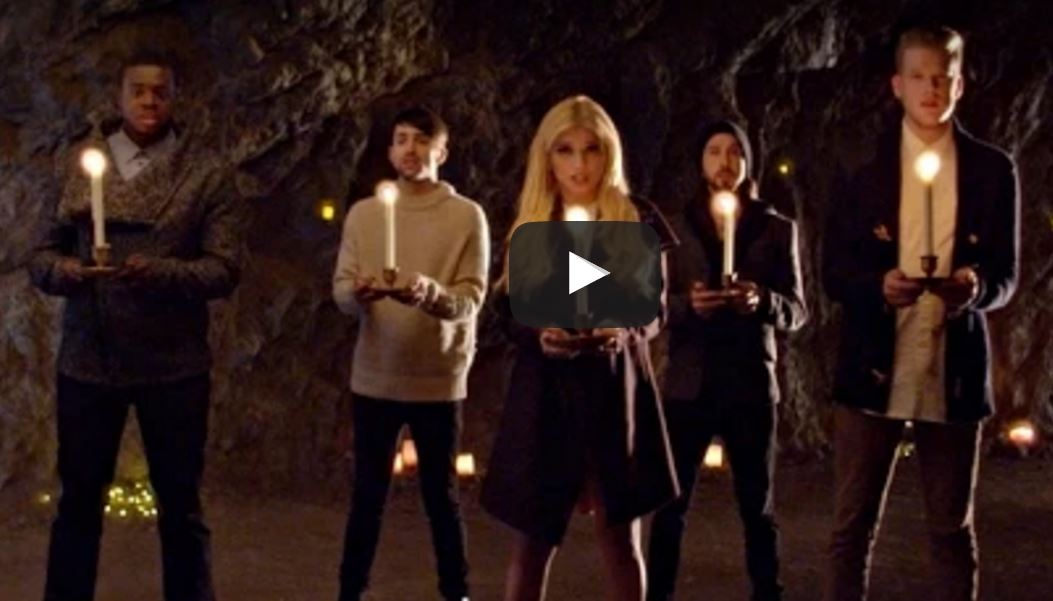
Enjoy this phenomenal performance by Pentatonic and their version of God Rest Ye Merry Gentlemen this holiday season.

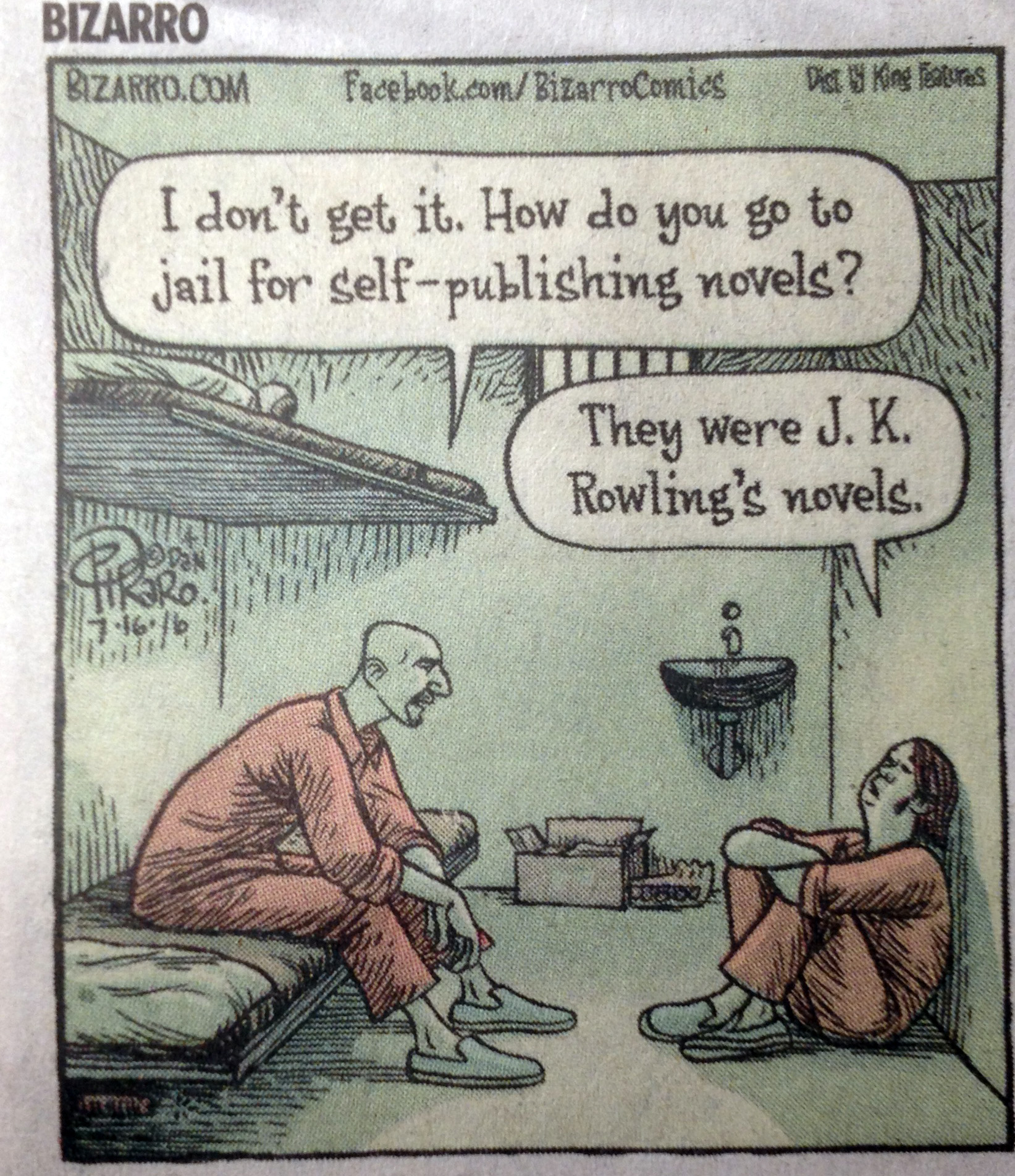
Bizarro by Dan Piraro

In Jail for Self-publishing?

By DAN PIRARO

If you have ever seen Dan Piraro’s critically acclaimed comic Bizarro (and you have: it is published daily in over 360 papers), you know that he doesn’t see the world like the rest of us do. His single panel gems are a unique concoction of surrealistic imagery, social commentary, and witty plays on words. Indeed, if Salvador Dali, Garry Trudeau and Oscar Wilde had an illegitimate child, that child would be Dan Piraro.


Be Happy

Enjoy this Holiday Season

with one of our favorite songs by Pentatonix

May your holiday be blessed with joy and happiness from our family to yours.
Anthony & Family

x  Powerful Protection for WordPress, from Shield Security
This Site Is Protected By
Shield Security